CERTIFICATION FOR POTENTIALLY EXPLOSIVE HYDROGEN LOCATIONS
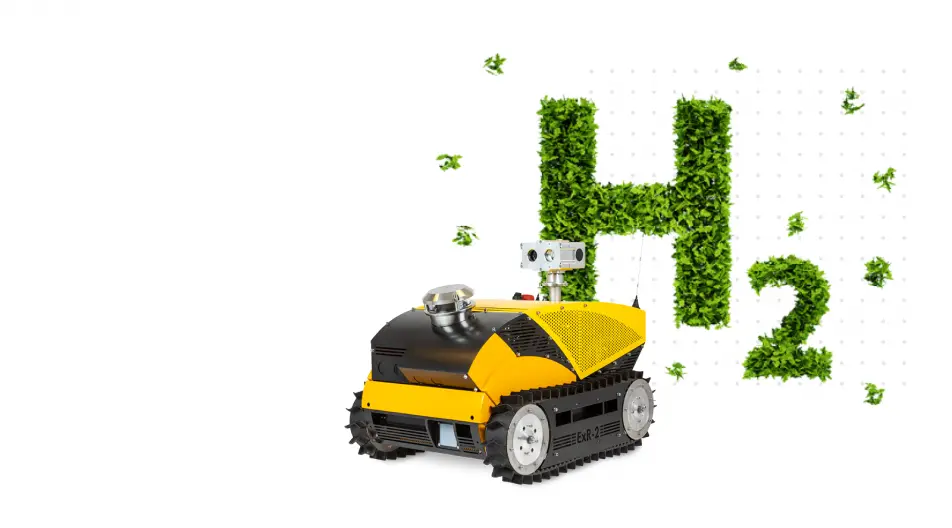
To date, designers of Ex robot operators have focused on potentially explosive hydrocarbon locations that are typically categorised as Ex Group IIB. Designers of Ex robot operators need to be preparing for the increase in potentially explosive hydrogen locations which are typically categorised as Ex Group IIC or Group IIB + H2. The former is designed for hydrogen, hydrocarbon and/or acetylene environments, the latter for hydrogen and hydrocarbon but not acetylene environments. The Ex robot designer will come to understand the design nuances that separate these two categories.
For brevity this article only refers to Group IIC. It summarises the differences between Group IIB and IIC designs that are most likely to affect Ex robot designers. There are a range of protection techniques to prevent an electrical spark triggering an explosion. Each is considered in turn before considering bought-in components and non-electrical issues.
INTRINSIC SAFETY (EX “I”)
The electrical energy within intrinsically safe equipment is incapable of igniting an explosion either through sparking or heating. This means the electrical energy must be controlled and the equipment must be protected from non-intrinsically safe circuits.
When comparing Group IIC to Group IIB from a design perspective:
- The minimum ignition current is less at the same voltage or inductance.
- The minimum ignition voltage is lower at the same capacitance.
- Permitted short circuit currents and capacitances are significantly lower.
- Piezoelectric devices can store less energy.
- Maximum output currents for Fieldbus intrinsically safe concepts (FISCO) are lower and must be temperature classified.
- The induction to resistance ratio that can be connected to a power source is lower which can affect cable selection.
Even if the design of the intrinsically safe, Group IIB device satisfies the requirements of Group IIC, it will need to be tested again in a hydrogen/acetylene (not hydrocarbon) atmosphere and with different currents/capacitances than were used for the Group IIB tests.
FLAMEPROOF ENCLOSURES (EX “D”)
If gas penetrates a flameproof enclosure and an explosion is triggered, the enclosure prevents the explosion from propagating to the external environment. This means the enclosure must be strong enough to contain the explosion and any gaps in the enclosure must dissipate the explosion’s energy before it reaches the external environment.
Hydrogen molecules are smaller than hydrocarbon molecules and are more able to travel along narrow gaps. Therefore Ex standards require gaps (flameproof joints) in Group IIC enclosures to be thinner and sometimes longer than those in Group IIB enclosures. Also some types of flameproof joints are prohibited (e.g. sleeve bearings).
All flameproof enclosure designs are tested to ensure they will contain any explosion. This is done in three stages:
- A reference pressure (the maximum pressure the enclosure must contain) is measured by triggering a gas explosion inside the enclosure.
- The pressure inside the enclosure is increased until it’s higher than the reference pressure. The enclosure must not be damaged.
- The enclosure and its surroundings are filled with explosive gas. An explosion is triggered inside the enclosure. The gas around the enclosure must not ignite.
The gas mixture used in Items 1 and 3 is representative of the Group for which the enclosure has been designed. If an enclosure has been certified for Group IIB locations, these tests will need to be repeated for mixtures of hydrogen and acetylene gases for Group IIC locations. There will also be adjustments to other test parameters. The results are unpredictable.
Switching from Group IIB to Group IIC has other implications for flameproof enclosures:
- It can be effective to use a single flameproof enclosure for different contents. They are tested as “empty enclosures”. The constraints for empty IIC enclosures are more restrictive than for IIB enclosures.
- Flanged IIC flameproof joints must be further away from obstructions than flanged IIB flameproof joints.
INCREASED SAFETY (EX “E”)
For increased safety, additional measures are applied to give security against high temperatures, electrical arcs and sparks. Typically this involves separating conductive items with different voltages. This means that the temperatures inside the enclosure must be controlled, conductive items need to be securely fastened, insulators need to satisfy minimum standards, and the enclosure must prevent ingress of substances that might reduce the separation between conductive items.
There’s only one, very specific difference in the requirements for Group IIB and Group IIC increased safety. Machine stators and cage rotors are tested to ensure they will not ignite an explosive gas. The type of gas used is different.
OTHER PROTECTION TECHNIQUES
Pressurised Enclosures (Ex “p”). These enclosures contain a pressurised gas. Gas cannot enter because the pressure is higher inside than outside the enclosure. This means the electrical equipment must shut-down if the over-pressure is lost and that any gas that is used to maintain pressure must not be explosive.
Powder Filling (Ex “q”). Powder filled enclosures are filled with quartz or glass particles. If gas penetrates the enclosure and an explosion is triggered the tortuous path around the particles dissipates the energy before it reaches the external environment. This means the size distribution of the particles must be controlled, there must be sufficient depth of particles surrounding the electrical equipment, and the enclosure must not fail when the internal pressure increases.
Liquid Immersion (Ex “o”). Electrical equipment is immersed in a liquid that separates it from any explosive gas. This means the level of the liquid in the enclosure must be controlled and the electrical equipment must be isolated if the level of the liquid is too low.
Encapsulation (Ex “m”). Electrical equipment is surrounded by a non-metallic solid. This means the compound must not conduct electricity and there must be no gaps through which explosive gas could migrate to the equipment.
There’s no distinction between Group IIB and Group IIC for these protection techniques.
BOUGHT-IN COMPONENTS
Most robots will include bought-in components that have been Ex certified by the supplier. Common examples are plugs, glands and barriers but they might also include items of sensing equipment or motors. The robot designer will need to ensure that these bought-in components are certified for Group IIC locations.
NON-ELECTRICAL CONSIDERATIONS
Ex robot operators are usually designed to resist potentially corrosive environments. However hydrogen brings particular challenges and the robot designer will need to ensure that suitable materials have been used. For example, some grades of steel are susceptible to hydrogen-induced stress fractures that can cause very rapid failures.
Other considerations reflect the fact that hydrogen explosions can be triggered with less energy than a hydrocarbon explosion:
- The maximum permitted power from radio signals is less for Group IIC than for Group IIB atmospheres. This is especially significant since non-tethered robot operators communicate using wireless signals.
- The maximum surface area and thicknesses of non-metallic parts are significantly less for Group IIC than for Group IIB. This is to limit the potential static electrical charge. This could affect for example the type of paint used.
- The maximum capacitance of isolated metal parts is less for Group IIC than for Group IIB to minimise the potential static charge.
On the plus side, the auto-ignition temperature of hydrogen in air is higher than many common hydrocarbons so a robot designed for Group IIB locations will not have hot surfaces that could trigger explosions in Group IIC locations.
CONCLUSION
Designers need to perform a thorough review of their robots to determine whether they can be certified for potentially explosive hydrocarbon locations. Those robots that use intrinsic safety and/or flameproof enclosures are most likely to need significant design changes.
Transform your
inspections